You’ve just blended what looked like a perfectly balanced smoothie — frozen banana, spinach, a scoop of plant-based protein powder (a powder made from sources like peas, rice, or hemp instead of whey, which comes from dairy) — and the result is somehow both gritty on your tongue and chalky at the back of your throat. If you’ve moved beyond basic frozen-fruit blends and started stacking vegan protein powders for macros (macros = macronutrients: the protein, carbohydrate, and fat totals you’re hitting per serving), you’ve almost certainly hit this wall. The grit isn’t a sign that something is wrong with you or your ingredients. It’s a predictable outcome of specific physical properties that plant proteins have and whey doesn’t — and once you understand the mechanics, you can engineer your way around them on any blender from a $100 NutriBullet Pro to a $650 Vitamix A3500. This guide explains the tradeoffs clearly, shows you the math, and ends with a decision rule you can use today.
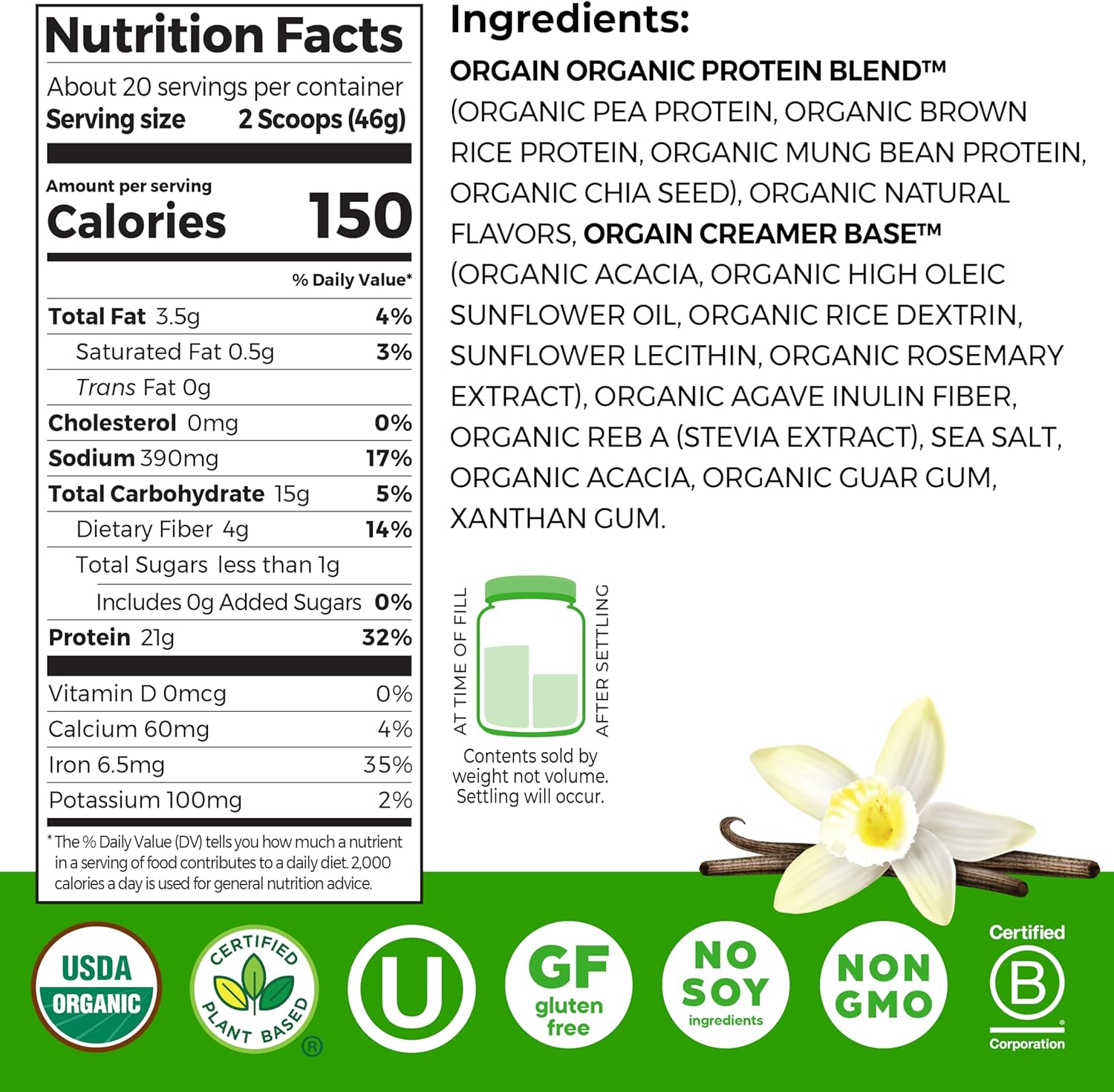
| EDITOR'S PICK[Orgain Organic Vegan Protein +…](https://www.amazon.com/dp/B00J074W94?tag=greenflower20-20) | Mid-tierGarden of Life | Budget pick[Just Hemp Foods Hemp Protein Po…](https://www.amazon.com/dp/B017JB6M86?tag=greenflower20-20) | |
|---|---|---|---|
| Protein (serving) | 21g | — | 11g |
| Fiber (serving) | 9g | — | 11g |
| Weight (total) | 2.02 lb | 1.37 lb | 1 lb |
| Flavor | Chocolate Fudge | Vanilla | — |
| Gluten free | ✓ | ✓ | — |
| Price | $34.15 | $29.77 | $8.22 |
| See on Amazon → | See on Amazon → | See on Amazon → |
Why Plant Proteins Are Structurally Different From Whey
Whey protein (the dairy-derived standard that plant powders are often compared against) is a globular protein that disperses readily in liquid because of its hydrophilic (water-attracting) molecular surface. Plant proteins — pea, brown rice, hemp, and sacha inchi being the most common — are predominantly storage proteins with larger particle sizes and a higher degree of insoluble fiber co-processed alongside the protein isolate.
Per Examine.com’s pea protein compound summary, pea protein isolates typically carry particle sizes in the 50–200 micron range before hydration, compared to whey concentrate particles that often fall below 100 microns. That gap matters: larger particles require more mechanical shear force (the blade speed and turbulence your blender generates) and more hydration time to fully disperse. When either is insufficient, you taste the result as grit.
There’s a second variable: protein content per serving. Healthline’s overview of pea protein notes that high-quality pea isolates can reach 80–85% protein by weight per serving, which means the insoluble fraction — the stuff that doesn’t dissolve — is densely packed into every scoop. Brown rice protein is notably coarser; hemp protein retains the most fiber and fat (making it creamier but also the hardest to fully integrate at lower blade speeds); pea protein isolate sits in the middle and is generally considered the easiest plant source to blend smooth.
A 2023 study published in the Journal of Food Science on particle size and hydration effects on plant protein dispersibility found that pre-hydrating plant protein powders for as little as 90 seconds before adding frozen or cold ingredients meaningfully reduced residual particle size in the final blend — a finding that applies directly to home blending protocol.
By the numbers:
- Pea protein isolate particle size: ~50–200 microns (pre-blend)
- Whey concentrate particle size: ~30–100 microns (pre-blend)
- Pre-hydration window that improves dispersibility: 60–120 seconds, per the Journal of Food Science study above
- Motor threshold where full plant protein dispersion becomes reliable: ~2.0 peak horsepower (HP), based on published manufacturer motor ratings
The Four Levers You Actually Control
Understanding the problem is half the battle. The other half is knowing which of the four main variables to adjust first — and in what order — so you’re not throwing money at a blender upgrade when the fix is a 90-second protocol change.
1. Hydration sequence (biggest impact, zero cost)
The single most underused fix is adding your liquid and protein powder first, blending briefly on low for 60–90 seconds, then adding your frozen fruit and other solids. This gives the powder a head start on dispersibility before the thermal shock of frozen ingredients thickens the mixture and reduces blade penetration. Sunwarrior’s Warrior Blend product page explicitly recommends this sequence for their brown rice / pea blend, noting that pre-dispersing in room-temperature liquid reduces graininess significantly.
2. Liquid volume relative to powder mass
Most grit complaints trace back to under-liquiding. As a rule of thumb: one scoop (approximately 25–30g) of plant protein powder needs a minimum of 10–12 oz of liquid to reach full dispersibility in a standard 32 oz blender jar. Many recipes call for 8 oz to keep calories tight — which is fine for whey but marginal for plant proteins. Adding 2–4 oz of liquid is the lowest-friction fix before you escalate to equipment or ingredient changes.
3. Ingredient temperature
Cold base liquids and frozen fruit drop the blending temperature rapidly, which increases viscosity (thickness) and reduces the blender’s ability to generate adequate shear. If you’re using a mid-range blender (Ninja Professional, ~$150, peak 2.25 HP per published specs), starting with room-temperature liquid before adding frozen ingredients can meaningfully extend the effective blend time before the motor throttles back under load.
4. Blend duration and cycle pattern
Pulsing vs. sustained blending affects texture differently. On high-RPM personal blenders (NutriBullet Pro, ~$100, 900W / ~1.2 HP peak), sustained high-speed blending of 45–60 seconds consistently outperforms short pulse cycles for plant protein integration, because pulses don’t sustain the turbulence long enough to break down larger particles. On full-size countertop blenders with variable speed controls — the Vitamix A3500 being the category benchmark at $650+, with manufacturer-rated 2.2 peak HP and variable speed from 1 to 10 — the recommended approach per Vitamix’s published usage guides is to ramp from low to high over 10–15 seconds, then hold high for 30–45 seconds. This prevents air pockets from forming at the blade base, which is a common cause of incomplete blending that leaves grit in the bottom third of the jar.
Equipment Decision Frame: Where Your Blender Becomes the Bottleneck
Here’s the honest read on when equipment is actually the limiting factor versus when protocol fixes will solve it:
Entry-level personal blenders ($40–$120 range: NutriBullet Pro, Magic Bullet, similar) Reviewers at Wirecutter’s best blenders guide consistently note that personal cup blenders work well for whey-based smoothies but struggle with high-density plant protein powders, especially brown rice and hemp, due to lower peak HP and shorter sustained run times before thermal cutoff. If you’re on a personal blender and following the hydration sequence above and still getting grit — this is likely a true equipment ceiling, not a protocol failure. The fix is moving to a mid-range countertop blender.
Mid-range countertop blenders ($130–$200 range: Ninja Professional, Oster Versa, similar) At this tier, published motor ratings (~2.0–2.25 peak HP) are generally sufficient for pea protein isolate and most blended plant protein products if protocol is correct. Brown rice protein is the hardest call at this tier — owners in aggregated reviews consistently report that brown rice protein blends smoother when pre-hydrated but remains slightly detectable in texture even at full blend duration. If brown rice is your primary protein source and texture is a priority, this is where the Vitamix or Blendtec upgrade conversation becomes financially defensible.
Performance countertop blenders ($400–$700 range: Vitamix A3500, Blendtec Designer 725) The Vitamix A3500 is manufacturer-rated at 2.2 peak HP with a narrow blade profile in a 64 oz container designed to create a tight vortex — the engineering that makes it effective for high-viscosity plant protein blends at full batch sizes. The Blendtec Designer 725, rated at 3.8 peak HP per published specs, generates more raw motor force and is particularly well-regarded by small-batch food entrepreneurs and smoothie bar operators (a strong secondary segment at this price point) for consistent results across high-volume sessions. Owners in long-run reviews note that both units achieve smooth plant protein integration without pre-hydration on most formulations, though the hydration sequence still improves results with hemp protein specifically.
If X, then Y — the decision rule:
| Your situation | The right move |
|---|---|
| Protocol not optimized yet (no pre-hydration, low liquid volume) | Fix protocol first. Zero spend. |
| Personal blender, protocol optimized, still gritty | Step up to mid-range countertop (~$150). |
| Mid-range blender, brown rice protein is your base | Vitamix/Blendtec upgrade is financially defensible. |
| Mid-range blender, pea protein isolate is your base | Protocol optimization likely solves it without upgrade. |
| Running a smoothie bar or high-volume meal prep | Blendtec Designer 725 or Vitamix commercial line from the start. |
Ingredient Substitutions That Reduce Grit Risk Without Changing Your Macro Stack
If upgrading equipment isn’t the current priority, adjusting your ingredient mix can bridge the texture gap. These swaps are macro-neutral or close to it:
Swap brown rice protein for a pea/rice blend. Brands like Sunwarrior’s Warrior Blend and Garden of Life Sport Organic combine pea and rice protein in a ratio that improves solubility over single-source rice protein, with a comparable amino acid profile. Published third-party amino acid profiles for Sunwarrior Warrior Blend show leucine content (the key muscle-protein-synthesis trigger) at approximately 1.8g per 25g serving, which is competitive with most single-source plant isolates.
Add a fat source before the powder. A tablespoon of Laird Superfood Creamer, nut butter, or coconut cream before blending creates a lipid-coated environment that some plant protein particles disperse into more readily than plain water — a technique food scientists call emulsification. It adds 70–120 calories depending on the fat source, so it’s worth logging if you’re tracking macros tightly.
Use a ripe, frozen banana as your base. The pectin content in frozen banana creates a smoother binding matrix than ice or plain frozen berries, which is why it’s a structural workhorse in plant protein smoothies even when the banana flavor isn’t the point. If you’re avoiding the glycemic load of banana (a real concern for blood sugar management), frozen zucchini or cauliflower achieves a similar binding texture at a fraction of the carbohydrate cost — a substitution that Healthline’s smoothie ingredient overviews consistently surface as a legitimate alternative.
The Bottom Line
Gritty plant protein smoothies are almost always a fixable problem, and the fix is usually sequenced: start with protocol (pre-hydrate, increase liquid volume, ramp your blender speed), then evaluate whether your protein source itself is the hardest-to-blend option for your equipment tier, then ask whether the equipment ceiling is real or just under-utilized. For most practitioners on a mid-range countertop blender using pea protein isolate, protocol changes alone eliminate grit entirely. For brown rice protein enthusiasts on a personal blender, the honest answer is that you’ve hit a real equipment ceiling — and the upgrade math to a Ninja Professional or comparable mid-range unit is straightforward at ~$150. The Vitamix A3500 and Blendtec Designer 725 earn their price premium for anyone running high volume or insisting on smooth results from the most difficult plant protein sources without the workaround — but they’re not required for great results if your protocol is solid.
Fix the sequence first. Buy the blender second, if you still need to.