If you’ve ever stood in a big-box store aisle — or scrolled through an endless product page — staring at a wall of Ninja blenders, all with different letter-number combinations and overlapping price tags, you’re not confused because you’re missing something. You’re confused because Ninja genuinely publishes more than a dozen active blender SKUs at any given time, spanning roughly $60 to $250. A SKU, short for “stock keeping unit,” is just retailer-speak for a distinct product variant. The lineup ranges from personal single-serve cups (you blend and drink straight from the same container) all the way up to full-size countertop pitchers with multiple speed settings and Auto-iQ programs — pre-set blending sequences the machine runs on its own. This guide maps each tier to real workflow needs: what kind of smoothies you’re making, how often, and what you’ll be blending into them. By the end, you’ll have a clear decision rule, not just a feature list.
| EDITOR'S PICK[Ninja BL660 Professional Compac](https://www.amazon.com/dp/B00939FV8K?tag=greenflower20-20)… | Mid-tierNinja Professional Blender | Sm… | Budget pick[Ninja Fit Compact Personal Blen](https://www.amazon.com/dp/B01FHOWYA2?tag=greenflower20-20)… | |
|---|---|---|---|
| Wattage | 1100 | 1000 | 700 |
| Pitcher Size | 72 oz. | 72 oz. | — |
| To-Go Cups | 2×16 oz. | — | 2×16 oz. |
| Food Processor | ✓ | — | — |
| Price | $139.00 | $89.97 | $59.00 |
| See on Amazon → | See on Amazon → | See on Amazon → |
Why the Ninja Lineup Is Genuinely Confusing (and How to Read It)
Ninja uses a model-naming system that prioritizes retail channel exclusivity over consumer clarity. The same motor platform often ships under three or four different model numbers — one for Walmart, one for Amazon, one for Costco — with minor differences in included accessories. According to Wirecutter’s “The Best Blenders” guide, this practice makes direct price comparison difficult because you can’t always confirm you’re looking at the same internal hardware across retailers.
The practical way to decode the lineup is to stop reading model numbers and start reading three specs instead:
- Peak motor wattage — how much power the motor draws at its maximum load. Higher wattage handles frozen fruit, leafy greens, and dense superfood powders more consistently.
- Container capacity and geometry — the size and shape of the pitcher determines whether the blender can create a proper vortex (the swirling pull that drags ingredients down into the blades). A tall, narrow pitcher will underperform a well-designed wider one even at the same wattage on batch sizes under 16 oz.
- Blade assembly type — Ninja’s personal-cup blenders use a different blade stack than their full-size pitchers, and performance profiles differ significantly.
Here’s a fast orientation to where each major tier lands:
| Tier | Representative Model | Peak Watts | Typical Street Price (May 2026) |
|---|---|---|---|
| Personal Cup (entry) | Ninja Fit | 700W | ~$60 |
| Personal Cup (mid) | Ninja Nutri-Blender Pro | 900W | ~$90 |
| Full-Size (mid) | Ninja Professional BL610 | 1000W | ~$100–$120 |
| Full-Size + Auto-IQ | Ninja Foodi Power Pitcher | 1200W | ~$160–$200 |
| High-Performance | Ninja Detect Kitchen System | 1800W | ~$200–$250 |
Prices reflect aggregated retail tracking as of May 2026 and will fluctuate. The point isn’t the exact dollar — it’s the wattage-to-price relationship at each jump.
The Personal Cup Tier: Right Tool, Wrong Job (Sometimes)
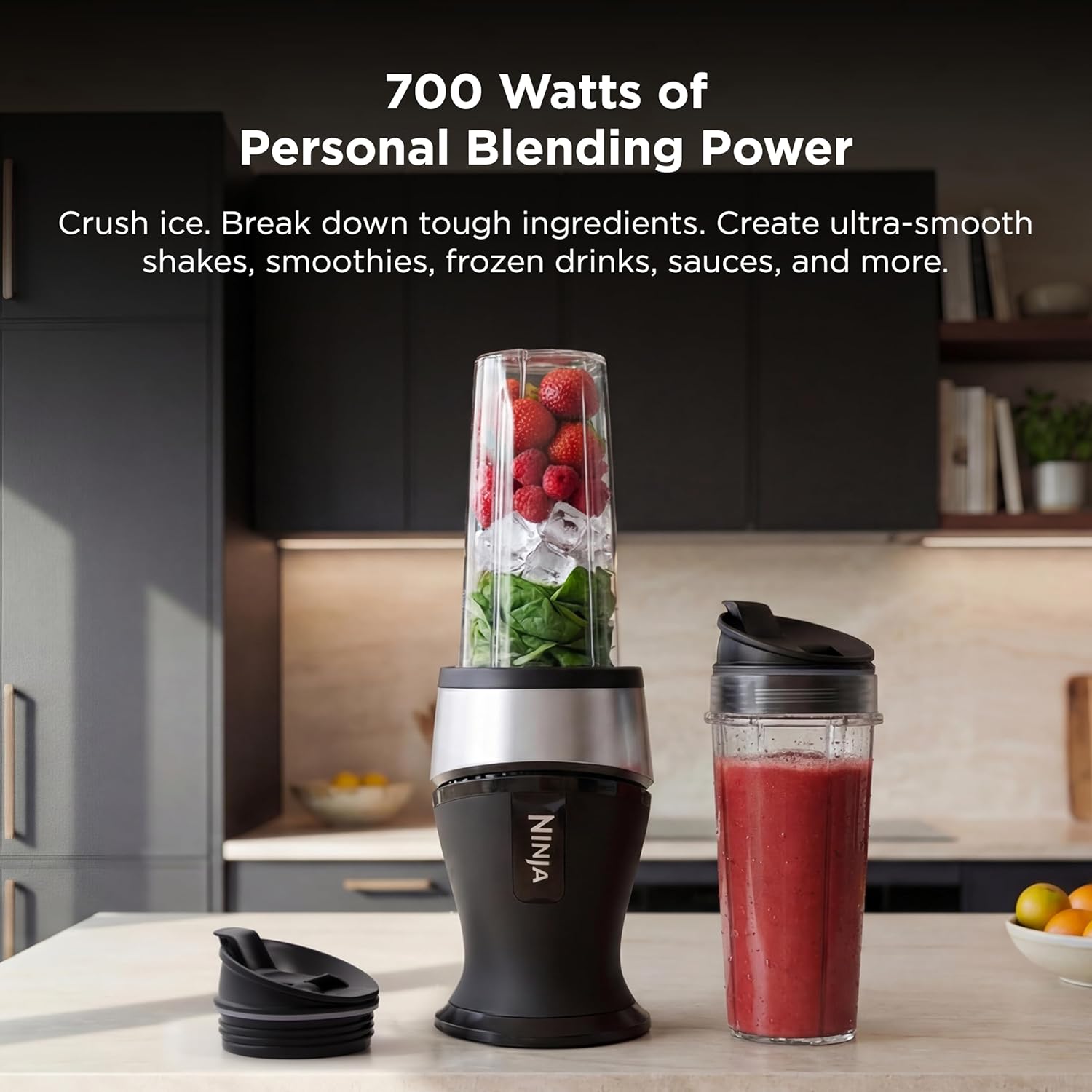
Ninja’s personal blenders — primarily the Fit (700W) and the Nutri-Blender Pro (900W) — are the easiest to recommend for a narrow use case and the easiest to over-buy or under-buy for everyone else.
Where they genuinely shine: Single-serve smoothies built on pre-frozen fruit, protein powder, and a liquid base. The blade assembly in Ninja’s personal cups is designed to pull ingredients down from the sides of a small-diameter container. For 16–24 oz blends with soft-to-medium ingredients, owners consistently report very smooth results, even with the 700W Fit. The grab-and-go design — blend in the cup, cap it, leave — reduces morning friction to near zero.
Where they fall apart: Anything requiring sustained high-torque blending. Nut butters, whole-food fat sources like frozen avocado cubes, large quantities of fibrous leafy greens, or superfood powders that clump — these expose the motor’s limits. At 700–900W under sustained load, owners across aggregated reviews note thermal cutoffs triggering more frequently than they do on full-size models. Serious Eats’ blender coverage consistently flags this: personal-cup blenders are not designed for continuous operation, and pushing them on dense ingredients shortens the duty cycle (the percentage of time a motor can run at peak load without overheating).
The upgrade math: The jump from 700W to 900W (Fit to Nutri-Blender Pro) is worth the ~$30 delta if you regularly add nut butter, frozen chunks larger than standard IQF (individually quick frozen) berry size, or dense powder blends. It is not worth it if your base recipe is liquid + pre-frozen fruit + one protein scoop. The Fit handles that fine.
Decision rule for this tier: If your smoothie is single-serve, liquid-forward, and ingredient complexity is low-to-moderate → Ninja Fit or Nutri-Blender Pro. If you’re stacking adaptogens, frozen greens bricks, or fat sources in a single cup → skip this tier entirely and buy up.
The Full-Size Mid-Range Tier: Where Most Readers Actually Live
The Ninja Professional BL610 and its near-variants represent the highest volume of Ninja blenders in active household use, according to Consumer Reports’ blender reliability survey data. There’s a reason: 1000W in a full-size container is a significant performance jump over personal-cup geometry, and street prices of $100–$120 land squarely in the budget zone where most people are actually shopping.
What the geometry change means in practice: A full-size 72 oz pitcher creates a vortex that pulls a much larger ingredient mass into the blade zone simultaneously. For batch smoothies — two to four servings prepped at once — this isn’t just convenient, it’s actually more efficient per blend. Owners report that frozen fruit blends to consistently smooth texture in under 45 seconds on the high setting, even without the Auto-iQ programs.
The honest limitation: At 1000W, the BL610 tier is not a Vitamix. It is not designed to run continuously on heavy commercial loads. Food & Wine’s blender coverage notes that Ninja’s mid-range full-size models perform well on smoothies and shakes but show limitations on tasks requiring sustained friction heat — like blending raw nuts to butter over 60+ seconds. For a smoothie workflow, this limitation rarely matters. For a meal-prep entrepreneur processing large nut-butter batches, it matters a lot.
Auto-iQ: Is it worth the step up? Auto-iQ — Ninja’s name for pre-programmed blend sequences that pulse and run automatically — adds roughly $50–$80 to the BL610’s price point when you step up to models like the Foodi Power Pitcher or similar Auto-iQ-equipped full-size options. For users who are still dialing in ratios and timing, Auto-iQ’s smoothie and extract programs remove guesswork. For experienced blenders who run manual sequences by feel, it’s a convenience feature, not a performance feature. The underlying motor platform in the Foodi Power Pitcher tier (1200W) does deliver meaningfully better performance on fibrous and frozen loads, though — so if you’re choosing between 1000W no Auto-iQ and 1200W with Auto-iQ for ~$50 more, you’re buying real power, not just automation.
Decision rule for this tier: If you’re making 2–4 servings per blend session, working with standard frozen fruit and powder stacks, and your budget ceiling is $150 → Ninja Professional BL610 is the honest pick. If you want the batch capability plus the ability to process tougher ingredient loads (frozen greens, flaxseed, dense protein concentrates) → step up to the 1200W Auto-iQ tier. The delta earns its keep.
The High-Performance Tier: When Ninja Competes With Vitamix Territory
The Ninja Detect Kitchen System and its stablemates at the $200–$250 price point represent Ninja’s most serious attempt at performance-grade blending. At 1800W peak draw and with a redesigned blade-pitch geometry, this tier is genuinely different hardware — not just a more accessorized version of the mid-range.
Per Wirecutter’s comparative blender analysis, the Detect-series models close a meaningful portion of the performance gap with entry-level Vitamix and Blendtec units on smoothie-specific tasks. The qualifier matters: on smoothie tasks. Continuous-duty rating, jar construction quality, and long-run reliability still favor the professional-grade brands for operators running five or more blending cycles per hour.
Who this tier actually serves:
- Home users who’ve outgrown the BL610 tier on ingredient complexity — regularly processing whole flaxseed, frozen beet chunks, or dense green blends — and aren’t ready to commit to a Vitamix A3500 ($650+)
- Small-batch meal-prep operators doing moderate daily volume who need better performance than mid-range but can’t justify commercial-grade spend
- Athletes and wellness devotees sourcing premium superfood powders (Sunwarrior, Four Sigmatic, Laird Superfood) who notice texture differences in finished blends — the 1800W motor reduces unblended powder pockets significantly, per aggregated owner reviews
The honest comparison to Vitamix: At $200–$250, the Ninja Detect tier is roughly one-third the price of a Vitamix A3500. It does not match the A3500 on build longevity, warranty terms (Vitamix’s seven-year full warranty vs. Ninja’s one-year limited), or continuous-duty performance. If you’re operating a boutique smoothie bar and running 50+ blends per shift, the Vitamix case closes itself. If you’re a home user or light-commercial operator running under 10 blends per day, the performance gap narrows considerably and the price gap stays very wide.
Decision rule for this tier: If you’ve maxed out the 1000–1200W tier on ingredient complexity and batch demands, and your budget ceiling is $250 → Ninja Detect Kitchen System is the clear step up. If your daily volume is high enough that equipment longevity becomes a cost-of-goods line item → the Vitamix A3500 or Blendtec Designer 725 are the right tools, and no Ninja model at current pricing closes that case.
The Clearest Decision Framework in Plain Language
Here’s the “if X, then Y” view of the full lineup:
- If you make one smoothie per day, ingredient complexity is moderate, and portability matters → Ninja Nutri-Blender Pro (900W personal cup)
- If you batch for multiple people or meal-prep 3–4 servings at once, budget is under $150 → Ninja Professional BL610 (1000W full-size)
- If you stack dense superfoods, frozen whole ingredients, or fibrous greens AND want batch capacity → Ninja Foodi Power Pitcher or equivalent 1200W Auto-iQ tier
- If you’ve genuinely outgrown mid-range performance and your ceiling is $250 → Ninja Detect Kitchen System (1800W)
- If daily volume is high, long-run reliability is a business cost, or you need commercial-adjacent duty ratings → Exit the Ninja lineup entirely; Vitamix Ascent Series or Waring commercial models are the correct tools
The Ninja lineup earns its market share because it delivers real performance at prices that the professional-grade brands don’t compete at. The trap is over-buying accessories you won’t use (Auto-iQ programs you’ll ignore) or under-buying motor capacity for ingredients you’re already using. Match the wattage to your actual ingredient stack, match the container size to your actual serving volume, and the right model becomes obvious.