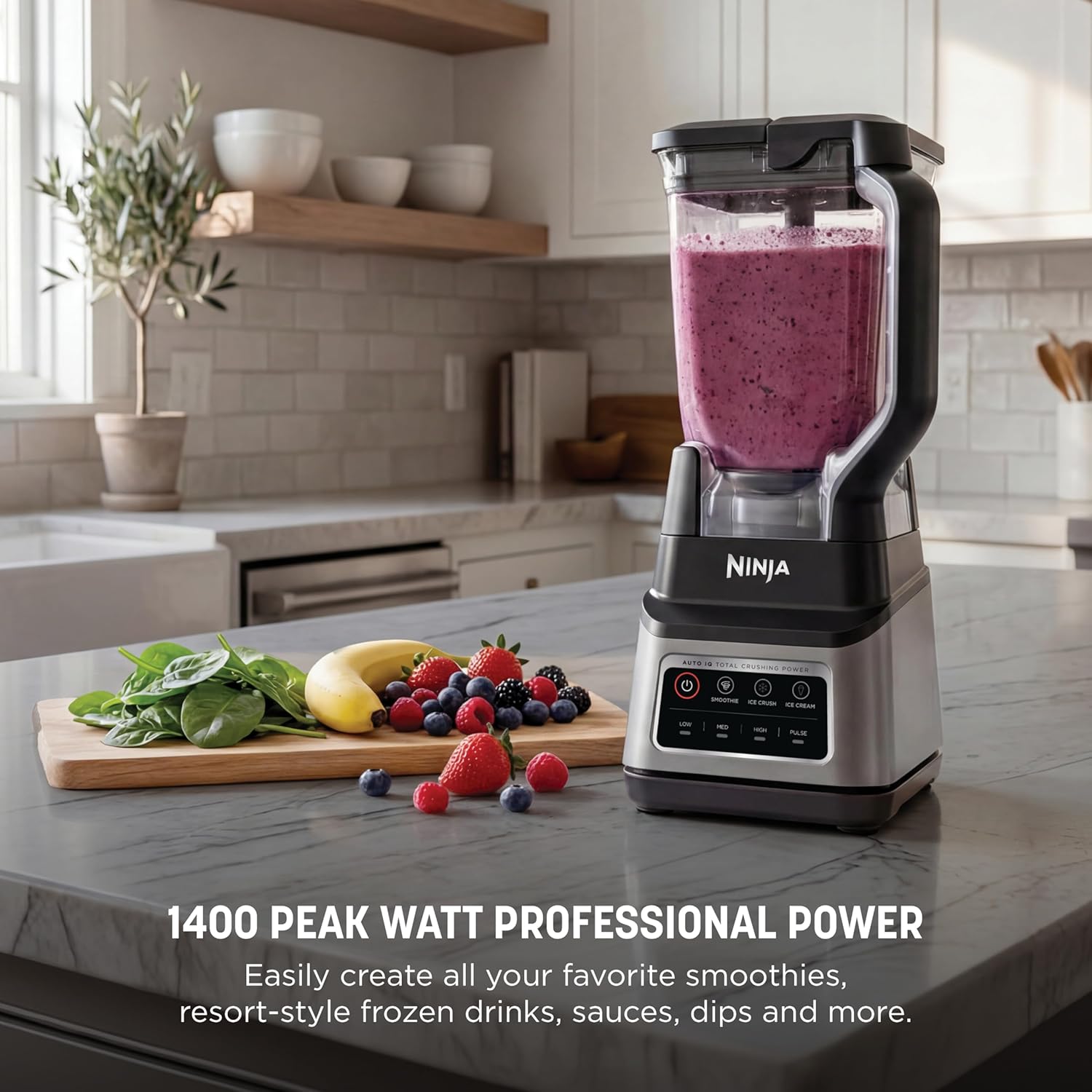
You’re standing in your kitchen looking at a Vitamix A3500 listing — $649, maybe more — while your Ninja Professional sits on the counter doing its job. It makes smoothies. It’s fine. The question gnawing at you isn’t “does the Vitamix exist?” You know it does. The question is: at what point does a $500 price gap actually translate into a meaningfully better result in the glass? That’s not a marketing question. It’s an engineering and use-case question, and it deserves a straight answer.
A blender’s core job is simple: spinning blades break food particles down into a drinkable texture. The difference between a $100 machine and a $650 machine isn’t magic — it’s motor power (measured in horsepower or peak watts), blade geometry, container design, and build longevity. Each of those factors matters differently depending on what you’re blending, how often, and what outcome you’re chasing. This article maps the spec gap to real-world scenarios so you can make the call with your eyes open.
| EDITOR'S PICK[Vitamix 5200 Blender](https://www.amazon.com/dp/B008H4SLV6?tag=greenflower20-20) | Mid-tier[Ninja Kitchen System](https://www.amazon.com/dp/B0CDDFH2MZ?tag=greenflower20-20) | All-in-O… | Budget pickNinja Professional Blender | Sm… | |
|---|---|---|---|
| Motor Power | — | 1500W | 1000W |
| Container Size | 64 oz | — | 72 oz |
| Blade Material | Stainless Steel | — | — |
| Included Cups | — | 2×16 oz | — |
| Food Processor | ✗ | ✓ | ✗ |
| Self-Cleaning | ✓ | — | — |
| Price | $447.50 | $129.99 | $89.97 |
| See on Amazon → | See on Amazon → | See on Amazon → |
The Actual Spec Gap: What You’re Paying For
Let’s anchor to real published numbers before anything else.
By the numbers:
- Ninja Professional (BL610): ~1,000W peak / 2.25 peak HP, 72 oz pitcher, no variable speed dial
- Vitamix A3500 (Ascent Series): ~1,440W / 2.2 HP continuous (not peak), 64 oz self-detect container, 5-speed dial + programmable
- Blendtec Designer 725: ~1,800W peak / 3.8 peak HP, 90 oz WildSide+ jar, touchscreen with 6 pre-programmed cycles
- NutriBullet Pro 900: 900W peak, 32 oz single-serve cup, no variable speed
The phrase that matters most in that list is peak versus continuous horsepower. Ninja and NutriBullet publish peak ratings — the motor’s max surge, not its sustainable output. Vitamix publishes continuous ratings, which Wirecutter’s blender guide identifies as the more meaningful number for tasks that require extended run times, like blending fibrous greens, nut butters, or frozen açaí. A motor rated at 2.2 HP continuous can sustain that output through a 60-second whole-food blend cycle without thermal throttling. Most mid-range blenders can’t.
Consumer Reports’ 2025 blender reliability data consistently places Vitamix and Blendtec at the top of predicted reliability scores, with entry and mid-range models showing meaningfully higher rates of motor degradation after 12–18 months of daily use. That’s the durability premium in quantified form.
Blade geometry and container shape also do real work here. Vitamix’s four-blade hammermill-style assembly inside a narrow-waisted container creates a vortex that pulls ingredients down and through the blade field repeatedly. Blendtec uses a blunt two-pronged blade (counterintuitive, but effective) inside a wide-base jar that generates a different turbulence pattern. Serious Eats’ blender coverage notes that container geometry — specifically the angle of the taper at the base — has as much influence on blend evenness as raw motor power, especially on sub-32-oz batches.
Where Mid-Range Machines Actually Hit Their Ceiling
The honest answer is that a Ninja Professional handles the smoothie tasks most people do most of the time. Frozen banana, protein powder, a handful of spinach, some almond milk — that’s a 45-second blend at high speed and the Ninja is done. If that’s your entire use case, the upgrade math is hard to justify.
But practitioners at the 6–24 month mark tend to have evolved their ingredient stacks. That’s where the ceiling shows up in specific, repeatable ways:
1. Fibrous whole-food ingredients. Kale stems, raw beets, whole flaxseed, frozen acai packs — these require sustained blade contact at high velocity to actually break down cell walls. Wirecutter’s testing notes (referencing their lab methodology) found that mid-range blenders frequently leave fibrous greens in detectable strand form at the 30-second mark where a Vitamix is already smooth. From a bioavailability standpoint, cell wall disruption matters: nutrients in leafy greens are more accessible when the cellular matrix is fully broken. Food & Wine’s 2025 high-performance blender coverage flags this specifically for spinach and kale applications.
2. Nut butters and seed processing. Making almond butter or hemp seed paste in a Ninja will work — once or twice. Owners in long-run reviews consistently report motor heat issues and shortened lifespan when mid-range machines run the dense, friction-heavy loads that nut processing requires. The Vitamix and Blendtec are spec’d and thermally designed for exactly this application.
3. Batch volume and commercial-adjacent use. If you’re prepping 4–6 smoothies at a time for meal prep, or operating a small smoothie bar, the Ninja’s 72 oz pitcher sounds competitive on paper. But the motor can’t sustain repeated high-load cycles the way a commercial-rated machine can. Serious Eats notes that Vitamix’s Ascent Series — and especially the commercial-adjacent Vitamix Venturist and Waring commercial line — are the appropriate tools once you’re past 3–4 full-pitcher cycles per session.
4. Texture precision for performance nutrition. Athletes and biohackers using Sunwarrior protein, Four Sigmatic mushroom powders, or Laird Superfood creamers are often stacking 8–12 ingredients per blend. At that complexity level, incomplete blending doesn’t just affect texture — it creates uneven powder distribution, which affects both taste and predictable macro delivery per serving. Per Food & Wine’s coverage, high-performance blenders produce measurably more uniform emulsification of fat-and-water ingredients (think avocado plus liquid) than mid-range machines.
The Decision Frame: Which Upgrade Path Fits Which Use Case
Here’s where the practitioner-level decision lives. The spec gap is real. The question is whether your use case is wide enough to fall into it.
If you blend daily, use fibrous whole foods, and care about long-term reliability: The Vitamix A3500 is the clear answer. At ~$649 retail as of May 2026, it’s the machine Wirecutter calls its top pick for serious home blenders, and Consumer Reports gives it top reliability marks. The A3500’s self-detect container system and programmable settings aren’t gimmicks — they reduce friction for daily use. If cost is the friction point, the Vitamix E310 (Explorian Series, ~$350) delivers the same continuous-rated motor and container geometry without the programmable interface. That’s the buy for someone who wants professional motor performance but doesn’t need smart settings.
If your use case is primarily single-serve and performance nutrition:
The NutriBullet Rx ($150) or the smaller-footprint Vitamix S30 personal blender ($400 when available) are worth considering before you commit to a full-size countertop machine. Batch blending isn’t always the goal. If you’re making one precisely-measured blend per day and storing it, container geometry on a personal blender matters more than the full-size pitcher you’d only fill to 30% capacity anyway.
If you’re running a micro-business or small smoothie bar: Skip the consumer Vitamix entirely and look at the Vitamix Ascent A3500i (commercial-interface variant) or Waring commercial blenders. Waring’s commercial line (specifically the MX1050XTX) is rated for continuous commercial duty in a way that no consumer machine — including Vitamix’s home lineup — is designed for. Thrive Market and iHerb are solid sourcing channels for bulk superfood inputs once you’re operating at that volume.
If your Ninja is less than 18 months old and your ingredient stack is still mostly frozen fruit and protein powder: Don’t upgrade yet. You haven’t hit the ceiling of your current machine for your current use case. Spend the $500 price difference on ingredient quality — premium frozen organic açaí, grass-fed collagen, or a Sunwarrior blend pack — and revisit the hardware decision when you start noticing specific blend-quality failures.
The Longevity Math (and Why It Actually Changes the Decision)
The objection you’ll hear from Vitamix skeptics is: “It’s a blender. Why would I spend $650 on a blender?” The honest counter isn’t emotional — it’s arithmetic.
A Ninja Professional at $150, based on Consumer Reports reliability data and aggregated owner reviews, has a median useful life under daily use of approximately 2–3 years before motor degradation becomes noticeable. That’s $50–75 per year of ownership.
A Vitamix A3500 at $649, with Vitamix’s published 10-year full-warranty coverage (the longest in the consumer blender category by a significant margin), pencils out to $65 per year at minimum — and owners in long-run reviews routinely report 12–15 year lifespans. The per-year cost converges. The performance diverges.
That’s not a rationalization. It’s the actual frame serious purchasers should be using. Apartment Therapy’s appliance-investment coverage has made the same point about premium kitchen equipment in general: the sticker price is the wrong unit of comparison; cost-per-year is the right one.
The Bottom Line: If X, Then Y
The decision rule is cleaner than the marketing makes it sound:
- If you blend 5+ times per week, use whole fibrous ingredients, and plan to own your machine for 5+ years → buy the Vitamix E310 or A3500. The motor and longevity justify the price.
- If you batch-blend for 3+ people or operate any kind of food service → go commercial-adjacent (Vitamix Ascent commercial, Waring MX series). Consumer machines — including the Vitamix home line — aren’t designed for that duty cycle.
- If you blend 3x per week or fewer, mostly frozen fruit and powders → stay mid-range (Ninja Professional or Ninja Foodi Power Pitcher) and invest in ingredient quality instead.
- If you want professional motor performance at a softer price point → the Vitamix E310 at ~$350 is the most defensible buy in the lineup. Same motor, no touchscreen premium.
The Vitamix is worth it. But it’s worth it for a specific user profile, not universally. Know which profile you are, match the machine to it, and the price gap stops feeling like a splurge and starts feeling like the obvious call.