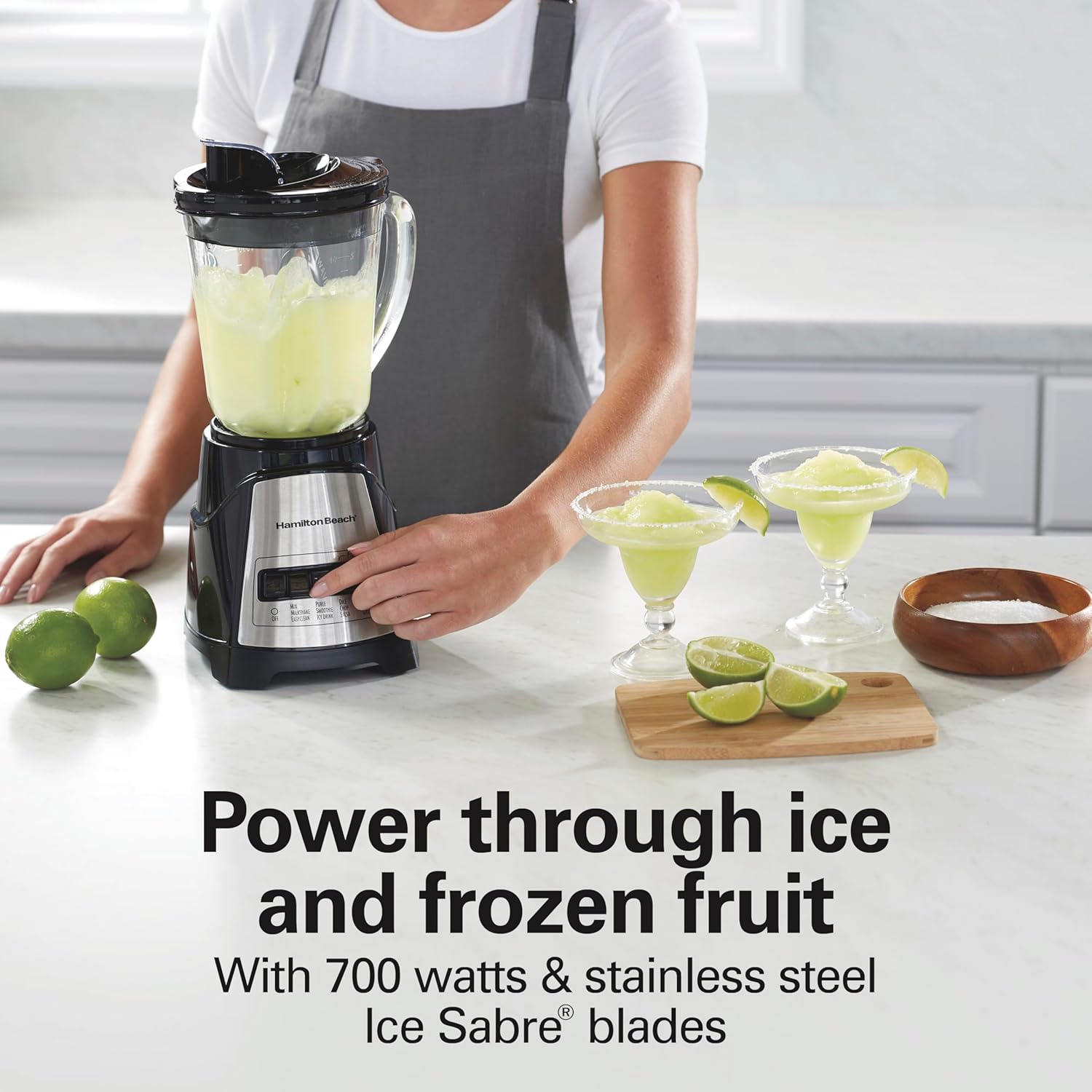
You pull the lid off your blender — let’s call it what it is, that $35 white plastic model from the big-box store — and stare at a smoothie that looks more like chunky soup than the silky result you were chasing. The frozen mango is still in recognizable chunks. The kale is stringy. The chia seeds might as well have stayed in the bag. If you’ve been blending for six months or longer and this scene is familiar, you’re probably not doing anything wrong. Your machine is just hitting its physical limits. A blender’s job is to use a spinning blade and a precisely shaped container (called the “jar geometry”) to pull ingredients down into a vortex and break them into uniformly tiny particles. Budget blenders — those in the $30–$50 price tier — are engineered to pass a visual standard at a retail shelf display, not to sustain that mechanical work under real-world ingredient loads. This article will show you exactly where those limits live, what they’re costing you in texture and nutrition, and give you a clear decision rule for when it’s worth spending more.
| EDITOR'S PICK[Cleanblend Commercial Blender w…](https://www.amazon.com/dp/B0094B94BM?tag=greenflower20-20) | Mid-tier[BLACK+DECKER PowerCrush Multi-F…](https://www.amazon.com/dp/B07RQVL8D5?tag=greenflower20-20) | Budget pick[Hamilton Beach Power Elite Wave…](https://www.amazon.com/dp/B08CG9LZJS?tag=greenflower20-20) | |
|---|---|---|---|
| Power (watts) | 1800W | — | 700W |
| Jar capacity | 64 oz | 6 cups | 40 oz |
| Jar material | — | Glass | Glass |
| Speed settings | — | 4 speeds | — |
| Blade material | Stainless steel | — | — |
| Warranty | 5-year full | — | — |
| Price | $178.97 | $46.99 | $39.95 |
| See on Amazon → | See on Amazon → | See on Amazon → |
What “Budget Blender” Actually Means in Engineering Terms
When we say budget blender, we’re talking about machines sold between roughly $30 and $55 in 2026 — brands like Oster Classic, Hamilton Beach Power Elite, and the lower Ninja lineup (not the Ninja Professional, which sits in a different tier around $100–$150). These machines share a set of defining characteristics that aren’t marketing failures; they’re intentional cost decisions.
Motor wattage: Budget blenders are typically rated at 300–600 watts. That wattage number represents the motor’s input power, not its output torque — a distinction that matters. Wirecutter’s blender testing methodology, documented in their updated 2025 guide, notes that peak wattage claims on budget machines are often measured under zero-load conditions, meaning the motor never actually delivers that number against real food resistance. Serious Eats’ 2024 deep-dive into blender mechanics explains the same gap: a 600-watt rating on a $45 machine and a 600-watt rating on a mid-tier unit can produce dramatically different results because of how motor winding quality and bearing grade determine sustained torque under load.
Blade metallurgy and geometry: Budget blades are typically stamped from thinner stainless steel with less aggressive attack angles. They’ll move ice and soft fruit reasonably well in short bursts but deflect rather than cut when they hit dense frozen blocks or fibrous greens like kale and collard stems.
Jar geometry: This is the piece most buyers overlook. The shape of the blending container determines how efficiently ingredients cycle down into the blade zone. Wide, flat-bottomed jars (common on budget models) let ingredients sit in “dead zones” at the sides rather than circulating. Narrower, tapered jars — standard on Vitamix and Blendtec units — actively pull food toward the blade. Per published specs and owner reports across aggregated review platforms, this geometric difference alone accounts for a significant portion of the texture gap between price tiers, independent of motor power.
Thermal protection and duty cycle: Budget motors overheat. Most are not engineered with meaningful thermal cutoffs; instead, they simply burn out after repeated heavy-load blending sessions. Consumer Reports’ 2025 reliability survey of small kitchen appliances identified blenders in the under-$60 tier as the category with the highest reported motor failure rate within 18 months of purchase, with heavy users (defined as 5+ blends per week with frozen or dense ingredients) seeing failure in under a year.
The Three Real Costs You’re Paying Right Now
1. Texture — and Why It’s Not Just Aesthetic
If your smoothie is gritty, chunky, or inconsistently blended, you’re not just dealing with a sensory disappointment. Texture is a proxy for particle size, and particle size has documented nutritional consequences.
Research published in Nutrition Journal (BioMed Central, 2023) on particle size and nutrient bioavailability in blended foods found that smaller, more uniform particle sizes increase the surface area exposed to digestive enzymes, improving the rate at which nutrients like carotenoids and fat-soluble vitamins are absorbed. Coarsely blended greens — the kind a 400-watt budget motor produces from kale or spinach stems — deliver measurably lower bioavailability than the same greens processed to a fine, uniform consistency by a high-torque machine.
For performance-nutrition users stacking adaptogens, collagen peptides, or superfood powders from brands like Sunwarrior or Laird Superfood, incomplete blend integration is a real issue: those powders clump and sink rather than dispersing homogeneously, meaning you’re paying premium ingredient prices for inconsistent dosing.
2. Ingredient Waste and Workarounds That Eat Your Time
Budget blender users develop unconscious workarounds: pre-cutting frozen fruit into smaller cubes, letting ingredients thaw for 10 minutes before blending, adding extra liquid to get the vortex moving, processing in multiple short pulses to prevent overheating. Each of these compensates for a mechanical shortcoming — and each costs time and degrades the result (more liquid means a thinner, lower-calorie-density smoothie; pre-thawed fruit produces a warmer, less texturally appealing blend).
If you’re spending 5–8 extra minutes of prep time per blend to make a $45 machine work, that’s a real cost worth quantifying over a year of daily blending.
3. Motor Replacement — the Hidden Cost Math
By the numbers:
| Machine | Avg. street price (2026) | Typical motor lifespan (heavy use) | Annualized cost |
|---|---|---|---|
| Budget blender ($35–$55) | ~$45 | 10–18 months | ~$30–$54/yr |
| NutriBullet Pro (~$100) | ~$100 | 3–5 years | ~$20–$33/yr |
| Ninja Professional (~$150) | ~$150 | 4–6 years | ~$25–$38/yr |
| Vitamix A3500 (~$650) | ~$650 | 10+ years (7-yr warranty) | ~$65/yr |
The budget blender looks cheapest until you factor in replacement frequency. An owner replacing a $45 machine every 14 months over a five-year horizon pays roughly $190 total — more than the cost of a mid-tier Ninja Professional or NutriBullet Pro that would outlast that window with better results at every blend.
Specific Upgrade Triggers: The “If X, Then Y” Decision Rules
This is where practitioners can stop second-guessing the decision. Here are the four clearest signals that your current machine is the constraint, not your technique:
Trigger 1: You’re blending frozen ingredients 4+ times per week. Frozen fruit and ice are the primary mechanical stress test for a blender motor. If your standard recipe includes a full cup or more of frozen mango, frozen cauliflower, or frozen acai, and your machine runs warm to the touch after a single cycle or requires multiple rest periods to finish the job, the motor is at or past its duty-cycle limit. Upgrade path: Move to the NutriBullet Pro 900 (single-serve, ~$100) or Ninja Professional (full-jar, ~$150) as the minimum viable step.
Trigger 2: You use fibrous greens (kale, collards, beet greens) more than occasionally. Budget blades don’t sever kale’s fibrous vascular strands; they fold them. The result is string-like texture that no amount of blending time fixes because the motor lacks the sustained torque to complete the cut. Owners of mid-tier and above machines consistently report that this texture gap is the single most noticeable improvement after upgrading. Upgrade path: Ninja Professional or higher; for daily green-heavy protocols, Vitamix A2300 or A3500 is the tier that fully eliminates this issue per published spec comparisons and long-run owner reviews.
Trigger 3: You’re paying for premium powders and they’re not integrating. If Laird Superfood creamer, collagen peptides, or adaptogen blends are clumping visibly in your finished smoothie, your motor isn’t generating enough blade speed to create the shear force that disperses these particles. You’re wasting expensive ingredients. Upgrade path: Any machine with a sustained blade tip speed above the budget tier — the NutriBullet Pro handles this adequately for most powder types; a Vitamix handles it completely.
Trigger 4: You’ve replaced your current blender once already. If you’re reading this article because you’re looking at your second $40 blender in two years, you’ve already paid mid-tier money in installments with none of the mid-tier results. This is the clearest green light to break the replacement cycle. Upgrade path: The Ninja Professional at ~$150 is the rational next step. If your blending volume is high (daily, multiple ingredients, batch prep) or you’re eyeing commercial-adjacent quality, the Vitamix Ascent A2300 at ~$450 is the machine that eliminates the ceiling entirely and carries a full 10-year warranty per Vitamix’s published product documentation.
One Honest Caveat: When the Budget Blender Is Still Right
Not every use case justifies an upgrade. If your blend is a daily banana-berry-yogurt smoothie with no frozen blocks, no fibrous greens, and no powders, a $45 machine with reasonable care will likely serve you for 2–3 years without complaint. Wirecutter’s 2025 guide explicitly notes that simple blends with soft ingredients are the domain where budget machines perform nearly on par with their pricier counterparts. Apartment Therapy’s 2025 piece on blender upgrades makes the same point: the gap is ingredient-dependent. Know your recipe stack before you commit to a $500 machine.
The Clear Recommendation
If you’re blending serious recipes — frozen bases, fibrous greens, superfood powders, or high-frequency daily protocols — the $30–$50 machine is not a money-saver. It’s a money-delay. The annualized cost math, the bioavailability evidence from Nutrition Journal’s 2023 research, the documented motor failure rates from Consumer Reports, and the consistent owner reporting on texture gaps all point to the same conclusion:
If you blend 4+ times per week with anything denser than soft fruit, move to a $100–$150 machine as your floor. The NutriBullet Pro 900 for single-serve users and the Ninja Professional for full-jar batches are the logical first upgrades — both represent a genuine mechanical step up, not just a marketing one.
If you’re blending daily with premium ingredients, running batch prep, or have already owned two budget machines, skip the middle tier and invest in a Vitamix Ascent Series. The cost math over five years is closer than it looks, and you will not buy another blender.
Your blender is a tool with a physical ceiling. Once you can see the ceiling, the only productive move is to raise it.