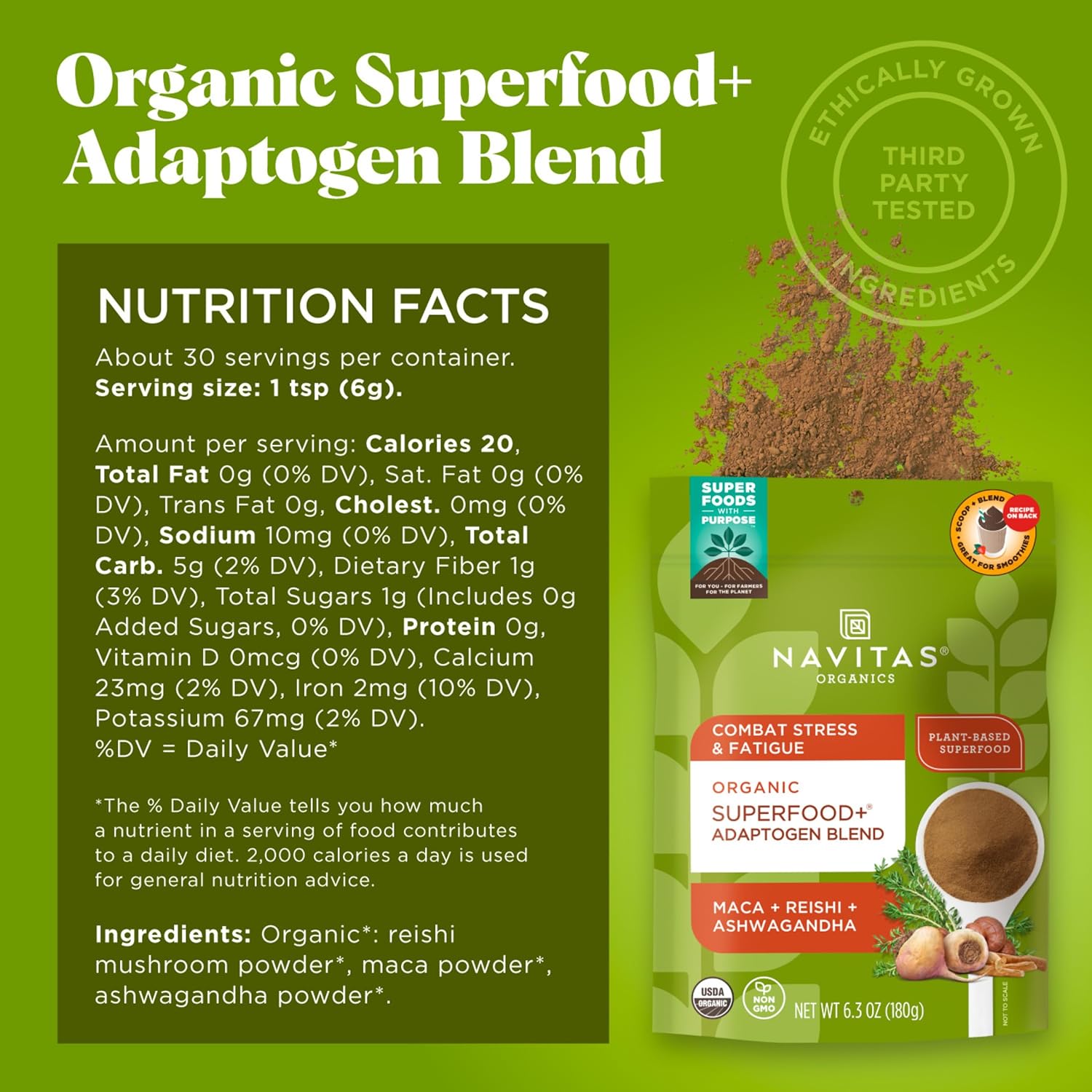
You’ve probably seen the word adaptogen on a jar of mushroom powder or a bag of ashwagandha and thought: okay, but what does that actually mean for my morning blend? Adaptogens are a class of herbs and fungi — think ashwagandha root, reishi mushroom, and rhodiola — that researchers believe help the body regulate its response to physical and mental stress. The idea isn’t that they fix a specific problem; it’s that they help your system return to balance faster after hard training, poor sleep, or a brutal travel week. For anyone using smoothies as a recovery tool, not just a breakfast shortcut, that sounds useful. But here’s the catch: the ingredient label on most adaptogen powders tells you almost nothing about whether you’re actually getting a dose that does anything.
This article is for the smoothie builder who has already moved past “throw some spinach and protein powder in a blender.” You know the language. You’re probably already using one or two superfood powders. What you may not have yet is a clear framework for stacking — choosing which adaptogens to combine, at what doses, in what base — without wasting money on label theater or accidentally undermining your own goals.
Why the Label Is Only Half the Story
Most adaptogen powders on the market list the ingredient and the serving size. What they often omit — or bury in fine print — is the extract ratio or standardized active compound percentage. Those two numbers are everything.
Take ashwagandha. A serving might say “500 mg ashwagandha root powder.” That sounds meaningful, but the research that supports ashwagandha for cortisol reduction — including the widely cited 2012 randomized controlled trial published in the Indian Journal of Psychological Medicine — used a full-spectrum root extract standardized to a minimum of 5% withanolides (withanolides are the active compounds responsible for the stress-modulating effect). A plain root powder with no standardization could contain a fraction of that concentration. You’d need to consume several times the serving size to hit a comparable dose, and the label gives you no way to know.
The same pattern shows up with mushroom adaptogens. Reishi, lion’s mane, and chaga powders vary enormously in whether they’re made from the fruiting body (the actual mushroom cap and stem, which concentrates beta-glucans — the immunomodulatory polysaccharides) or from mycelium grown on grain substrate, which delivers more grain starch than active compounds. ConsumerLab.com’s 2025 Mushroom Supplement Review found that mycelium-on-grain products can have active beta-glucan levels 10–20x lower than equivalent-weight fruiting-body products — a gap the label rarely surfaces.
What to look for instead of just the herb name:
- Ashwagandha: KSM-66® or Sensoril® extracts are standardized; generic “root powder” usually isn’t
- Mushrooms: look for “fruiting body” explicitly stated, plus beta-glucan % (target ≥20% for lion’s mane, ≥30% for reishi)
- Rhodiola: standardized to ≥3% rosavins and ≥1% salidrosides is the clinical benchmark
- Eleuthero (Siberian ginseng): eleutherosides B+E should be quantified; vague “root extract” is a yellow flag
The Stacking Decision Frame: What Goes With What (and What Competes)
Once you know your adaptogens are dosed correctly, the next question is combination logic. This is where most smoothie builders either over-stack or pick ingredients that work against each other’s timing.
Adaptogens broadly fall into two functional categories:
Calming/HPA-axis modulators — ashwagandha, reishi, holy basil (tulsi). These tend to reduce cortisol output and promote parasympathetic recovery. Better suited to post-training or evening smoothies.
Stimulating/performance adaptogens — rhodiola, eleuthero, cordyceps. These tend to support oxygen utilization, mental alertness, and energy availability under load. Better suited to pre-training or morning recovery windows.
Stacking both categories in the same smoothie isn’t automatically wrong, but it can be a wash if your goal is directional. If you’re making a 7 PM recovery smoothie to promote overnight repair and wind-down, loading it with cordyceps (which Examine.com’s 2025 summary notes may support VO2 max and energy output) is working against you. If you’re building a 6 AM pre-training blend, ashwagandha’s cortisol-blunting effect in that window may dull the acute stress response your body needs to drive training adaptation.
A simple if/then stacking rule:
| Goal | Lead adaptogen | Pair with | Avoid |
|---|---|---|---|
| Post-training recovery | Ashwagandha (KSM-66, 300–600mg) | Reishi fruiting body, magnesium glycinate | Rhodiola, cordyceps |
| Morning performance | Rhodiola (3% rosavins, 200–400mg) | Cordyceps fruiting body | Ashwagandha, holy basil |
| General stress + immunity | Lion’s mane + reishi | Vitamin C source (citrus, acerola powder) | High-caffeine stacks |
| Cognitive focus (daytime) | Lion’s mane (500–1000mg) | Phosphatidylserine, omega-3 base | Sedating mushrooms like chaga alone |
By the numbers:
- Effective ashwagandha range in published trials: 300–600 mg standardized extract daily (Chandrasekhar et al., 2012)
- Rhodiola dose associated with fatigue reduction: 200–400 mg of a 3% rosavin extract (Panossian & Wikman, 2010)
- Typical single-serving scoop in commercial blends: 100–250 mg — often below clinical threshold
That last line is the uncomfortable math. Many popular blends, including some from well-regarded brands, use doses that look impressive on the label but sit below the ranges where clinical research found meaningful effect. Laird Superfood’s Performance Mushroom Blend, for example, is transparent in its FAQ about why it positions its product as a daily-accumulation supplement rather than a single-serving therapeutic dose — which is honest, but means your single smoothie is not the whole protocol.
Base Composition: How Your Smoothie Ingredients Affect Adaptogen Bioavailability
This is the part almost no one talks about: the liquid and fat composition of your smoothie changes how well your body actually absorbs certain adaptogen compounds.
Withanolides in ashwagandha are lipophilic — they dissolve in fat, not water. A smoothie blended in plain water or a low-fat plant milk will absorb them less efficiently than one built on full-fat coconut milk, whole-food avocado, or a tablespoon of MCT oil. The same applies to reishi’s triterpene compounds. Healthline’s 2024 editorial overview of adaptogens notes that fat co-consumption is consistently flagged in formulation research as a bioavailability enhancer for fat-soluble botanicals, though most consumer products aren’t designed with that in mind.
Rhodiola’s active compounds (rosavins, salidrosides) are water-soluble, so base composition matters less there — but rhodiola is notably pH-sensitive. High-acid fruit additions (citrus, green apple, pineapple heavy) may partially degrade rosavin stability in a prolonged blend. Blend time is relevant too: at Vitamix A3500 speeds (~37,000 RPM blade tip speed), a 90-second aggressive blend generates friction heat. For temperature-sensitive compounds, a shorter pulse-and-blend approach preserves more active content. Operators in long-run reviews of the Blendtec Designer 725 note the smoothie cycle (pre-programmed, ~50 seconds) often performs better for supplement-loaded blends than manual full-speed runs.
Practical base recommendations by adaptogen type:
- Ashwagandha / Reishi / Chaga → full-fat coconut milk, unsweetened; or oat base + 1 tbsp MCT/coconut oil
- Rhodiola / Eleuthero → water, light nut milk, or low-acid fruit base (banana, mango, frozen berry — not citrus-heavy)
- Lion’s mane → relatively stable; pairs cleanly with any base; enhances with omega-3 fat sources (flaxseed, hemp hearts) for neurological support
Sourcing Decisions: Where to Spend and Where to Save
Premium adaptogens are not cheap. A 30-serving supply of properly standardized KSM-66 ashwagandha from a quality brand can run $25–45 at retail. Mushroom blends with verified fruiting-body content and third-party beta-glucan testing sit at $30–55 for 30 servings. Stack three or four powders and you’re looking at $80–150/month just in adaptogens, before your protein, frozen fruit, or greens.
Here’s the honest tradeoff matrix:
Worth paying more for:
- Any adaptogen where the active compound percentage matters (ashwagandha, rhodiola, mushrooms). Cheap standardized extracts often aren’t standardized at all — ConsumerLab.com’s 2025 review found label-claim failures in roughly 30% of mushroom supplements tested.
- Sunwarrior’s Warrior Blend and Four Sigmatic’s mushroom-specific powders publish third-party testing results and use fruiting-body sourcing — that verification premium is real.
Where you can rationalize the cheaper option:
- Tulsi (holy basil) powder has a more forgiving active-compound profile and lower variance between producers. Cost optimization here makes sense.
- Maca root: glycemic considerations aside, the dose-response for maca is flatter than ashwagandha, and the price delta between budget and premium is hard to justify based on published data.
For procurement, Thrive Market consistently prices standardized adaptogen powders 15–30% below retail MSRP on brands that don’t discount elsewhere. iHerb is worth checking for single-ingredient extracts from brands like Gaia Herbs and Herb Pharm, which publish standardization data reliably.
The Decision Rule
If you’re building or auditing your recovery smoothie stack right now, here’s the clear frame:
If your priority is post-training cortisol management and sleep quality → lead with KSM-66 ashwagandha (300–600 mg) in a full-fat coconut or avocado base, add reishi fruiting-body powder (1–2g), blend for 45–60 seconds max, and skip the stimulating adaptogens entirely from this smoothie. Morning is when those belong.
If your priority is cognitive sharpness and morning performance → rhodiola (200–400 mg, 3% rosavins) plus lion’s mane (500 mg fruiting-body) in a lighter, lower-acid base. Keep the blend short. Add cordyceps if VO2-adjacent performance is the target.
If you’re just starting adaptogen stacking → pick one, dose it correctly, run it for 30 days before adding a second. The combinatorial complexity is fun to theorize about, but your feedback loop for what’s actually working requires isolation first. Ashwagandha is the highest-evidence starting point across the published literature.
The label tells you what’s in the jar. This framework tells you whether it’ll do anything once it’s in your blender.